
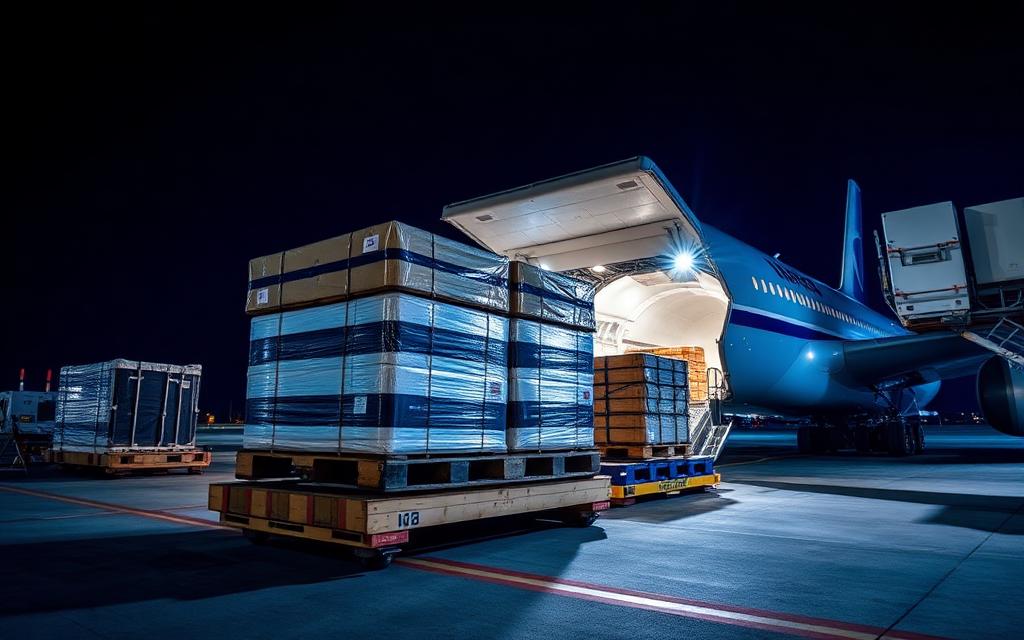
Why air freight is priced on more than just scales
One of the most common surprises for anyone shipping goods by air for the first time is discovering that the invoice is based not on what the parcel weighs on a set of scales, but on a figure called chargeable weight, which can be considerably higher than the actual weight. Aircraft have two hard limits on every flight: how much they can lift, and how much space is available in the hold. A small, dense item such as a machine part uses little space relative to its weight, while a large, light item such as a stack of packaging or an empty crate uses a great deal of space relative to its weight. If every shipment were billed purely by actual weight, airlines would lose money carrying bulky, lightweight cargo because it fills the hold long before the weight limit is reached.
To resolve this, the air freight industry uses a standard volumetric formula that converts the physical dimensions of a shipment into an equivalent weight, and then charges based on whichever figure is higher: the actual weight or the volumetric weight. This is not a mark-up or a hidden fee; it is a globally recognised method used by every airline and freight forwarder, published by IATA, and applied consistently regardless of which carrier or route is used. Understanding it before a shipment is packed, rather than after an invoice arrives, is the single most effective way to control air freight costs, because packing choices made at the outset directly determine which figure the airline will charge against.
The 1:6000 volumetric rule explained
The standard air freight volumetric formula divides the total volume of a shipment, measured in cubic centimetres, by 6000 to arrive at the volumetric weight in kilograms. Expressed as dimensions, this means multiplying length by width by height in centimetres, then dividing the result by 6000. A shipment measuring 100cm by 100cm by 100cm, for example, has a volume of one million cubic centimetres, which divided by 6000 gives a volumetric weight of 166.7kg. If that same box has an actual weight of only 60kg on the scales, the airline will charge for 166.7kg, because the volumetric figure is higher and reflects the true amount of hold space the shipment occupies.
The 6000 divisor is specific to air freight and should not be confused with the 5000 divisor still used by some couriers for smaller parcels, or the 1000 divisor used for sea freight volume calculations. Using the wrong divisor when estimating a quote is a common source of confusion, particularly for shippers who are used to sea freight pricing, where volume and weight are treated quite differently because ships are far less constrained by weight than by cubic space. Any dimensions should always be given in centimetres and kilograms when requesting an air freight quote, since a small unit error, such as confusing centimetres with inches, produces a dramatically incorrect volumetric weight and an unreliable quote.
Worked example: a light but bulky pallet
Consider a single pallet of lightweight display stands measuring 120cm by 100cm by 150cm, with a combined actual weight of 90kg. The volume is 120 multiplied by 100 multiplied by 150, giving 1,800,000 cubic centimetres. Dividing by 6000 gives a volumetric weight of 300kg. Because 300kg is far higher than the actual weight of 90kg, the shipment will be charged as though it weighs 300kg, more than three times its true weight. This is a completely typical outcome for lightweight, bulky cargo such as furniture, insulation, empty containers, textiles or foam packaging, and it explains why shippers of this type of cargo are so often surprised by the final invoice compared with their initial expectation based on the weighbridge ticket.
The practical lesson from this example is that reducing the physical footprint of a shipment, even without reducing its actual weight, can produce a meaningful cost saving. If the same display stands could be disassembled and packed flat, reducing the height from 150cm to 60cm, the volume falls to 720,000 cubic centimetres and the volumetric weight falls to 120kg, close to the actual weight and a saving of 60 per cent on the chargeable figure. This is why experienced shippers spend time on packing configuration before a quote is finalised, rather than treating the box or pallet dimensions as fixed and unchangeable.
Worked example: dense cargo where actual weight wins
The opposite scenario is equally instructive. A crate of machine tooling measuring 80cm by 60cm by 50cm has a volume of 240,000 cubic centimetres, giving a volumetric weight of 40kg when divided by 6000. If the actual weight of the crate on the scales is 180kg, the airline will charge for the actual weight of 180kg, because it is the higher of the two figures. In this case, the volumetric calculation is essentially irrelevant to the price, and the shipper gains nothing by trying to reduce the dimensions further, since the actual weight will remain the controlling figure regardless.
This distinction matters because it changes where effort should be focused when trying to control costs. For dense cargo such as metal parts, machinery, batteries or liquids, the priority is minimising actual weight through efficient packaging materials and avoiding unnecessary packing bulk, since the actual weight is what will be billed. For light, bulky cargo such as textiles, foam, plastics or assembled furniture, the priority is minimising the outer dimensions, since the volumetric weight is what will be billed. Knowing which category a shipment falls into before packing begins allows the packing process to be optimised for the figure that will actually determine the price.
How chargeable weight is calculated for multi-piece shipments
Most air freight shipments consist of more than one piece, and the chargeable weight calculation is applied slightly differently depending on whether the pieces are booked individually or consolidated as a single shipment. For a consolidated shipment, the volumetric weight of every individual piece is calculated and summed, and the actual weight of every piece is also summed, with the higher of the two totals becoming the chargeable weight for the whole consignment. This means that even if most pieces in a shipment are dense and weight-driven, a small number of bulky, light items mixed in can pull the overall chargeable weight up significantly, since the volumetric contribution of those pieces is added to the total regardless of how dense the rest of the shipment is.
For this reason, it is worth reviewing a full packing list against the chargeable weight formula before finalising a shipment, particularly where a mix of dense and light items is being sent together. Separating a shipment into two consignments is occasionally worthwhile if it allows dense cargo to travel on an actual-weight basis without being dragged up by a handful of bulky, light items, though this needs to be weighed against any minimum charge per shipment and the administrative cost of handling two consignments instead of one. Our freight desk routinely runs these comparisons before confirming a routing, since the cheaper overall option is not always the most obvious one on first inspection.
Packing discipline and its effect on chargeable weight
Packing discipline is the single biggest lever a shipper has over air freight cost, because every centimetre of unnecessary height, width or length is converted directly into chargeable weight through the volumetric formula. Common sources of avoidable bulk include oversized outer cartons with excessive void fill, pallets built taller than necessary because goods have been stacked loosely rather than compactly, protruding straps, pallet collars or corner boards that add a few centimetres on every side, and shrink-wrap applied so loosely that it creates an irregular, larger outer profile than the goods themselves require. Each of these adds only a small amount individually, but because dimensions are multiplied together in the volumetric formula, small increases on multiple sides compound into a meaningfully higher chargeable weight.
Good packing practice starts with using the smallest outer dimensions that safely protect the goods, squaring off pallets so that the tallest and widest points are consistent across the whole load rather than driven by one protruding item, and measuring the finished, packed shipment rather than relying on the manufacturer specification of the goods themselves. It is also worth photographing and measuring a shipment immediately before it is collected, since airlines and handling agents will re-measure and re-weigh cargo on arrival at the terminal, and any discrepancy between the quoted dimensions and the measured dimensions will be corrected and re-invoiced, sometimes at a less favourable rate than the one originally quoted.
Building an efficient pallet for air freight
Standard air freight pallets are typically built to fit the internal dimensions of aircraft unit load devices, and building to these standard footprints, most commonly around 120cm by 100cm or smaller, avoids wasted space and the higher chargeable weight that comes from odd, non-standard dimensions. Goods should be packed to use the full footprint of the pallet base wherever possible, rather than leaving gaps at the edges, since an irregularly shaped load is often measured at its widest points regardless of how much of that footprint is actually filled with goods. Heavier items should be placed at the base with lighter items above, both for stability during handling and because this arrangement tends to produce a lower, more compact overall shape than the reverse.
Where multiple smaller boxes are being consolidated onto a single pallet, arranging them in a uniform grid without protruding corners, and securing the load with tightly applied stretch wrap and edge protectors rather than loose strapping, keeps the outer profile as close as possible to the true volume of the goods. It is also worth considering whether goods can be shipped disassembled, since many items, from furniture to display equipment to certain types of machinery, have a significantly smaller footprint when broken down into flat-packed components than when shipped assembled, often reducing the volumetric weight by a substantial margin for a modest increase in packing and unpacking labour.
Airline and handling surcharges beyond the base freight rate
Chargeable weight is also the base used to calculate several surcharges that appear alongside the headline freight rate, so a higher chargeable weight increases cost in more than one place on the invoice. Fuel surcharges and security surcharges are almost always calculated per kilogram of chargeable weight, meaning that a shipment with a high volumetric weight will attract proportionally higher surcharges even though the actual physical weight being carried has not changed. Terminal handling charges at both origin and destination are also frequently weight-banded, so crossing from one weight band into the next because of a volumetric calculation can trigger a step change in handling cost rather than a small proportional increase.
Some destinations and airlines also apply minimum chargeable weight thresholds per shipment, commonly 45kg or 100kg brackets with different rates per kilogram above and below the threshold, which means a very small, light shipment can sometimes cost close to the same as a larger one simply because it falls below the first pricing break. Reviewing the full rate structure for a specific route, rather than assuming a single flat rate per kilogram applies throughout, is important when comparing quotes or deciding whether to combine several small shipments into one larger consignment to cross into a more favourable weight band.
Comparing air freight with sea freight for bulky, light cargo
Because volumetric pricing penalises bulky, light cargo so heavily, it is always worth comparing the air freight chargeable weight cost against a sea freight alternative for shipments that are not genuinely time-critical. Sea freight volume charges use a completely different divisor, based on cubic metres rather than the 1:6000 air freight rule, and for low-density cargo the cost per cubic metre by sea is typically a small fraction of the equivalent air freight cost, even after accounting for the additional transit time of several weeks rather than a few days. For urgent but bulky shipments, a hybrid approach using express road freight to a European hub, or airfreighting only the most time-critical portion of a consignment by air while the remainder follows by sea, can sometimes deliver a better balance of cost and speed than airfreighting the entire consignment.
This comparison is particularly relevant for cargo such as vehicle parts, display equipment, textiles and packaging materials, where the actual weight is modest but the assembled or boxed dimensions are large. Running both an air and a sea freight quote side by side before committing to a mode, using the actual measured dimensions rather than estimates, gives a realistic picture of the true cost difference and the trade-off against delivery speed, allowing the decision to be made on genuine figures rather than an assumption that air freight is always faster and sea freight is always cheaper without reference to the specific shipment.
Common mistakes when estimating chargeable weight
The most frequent mistake is providing dimensions based on the product specification sheet rather than the actual packed and palletised measurements, which almost always understates the true chargeable weight once packaging, pallets and any protruding fittings are accounted for. A second common error is mixing units, particularly quoting length and width in centimetres but height in inches, or vice versa, which produces a wildly inaccurate volumetric calculation and an unreliable quote that will need to be corrected once the shipment is physically measured at the terminal. A third mistake is failing to account for irregular shapes properly; airlines generally measure to the outermost points of a shipment, so an item with a single protruding bracket or handle will often be charged as though the entire shipment were as large as that protrusion, even if the main body of the goods is much smaller.
It is also a mistake to assume that a quote based on early, approximate dimensions will hold once the goods are actually packed, since even a modest increase in outer dimensions between the estimate and the final packed shipment can shift a consignment from an actual-weight basis to a volumetric-weight basis, or push it into a higher pricing band. Providing final, measured dimensions and weights as close as possible to the point of booking, and flagging any known irregular shapes or protrusions in advance, avoids invoice disputes and unexpected charges once the shipment has already been collected and is en route to the airport.
Practical steps to reduce your chargeable weight
Before booking an air freight shipment, it is worth working through a short checklist: measure the shipment in its final packed state rather than relying on manufacturer dimensions, calculate the volumetric weight using the 1:6000 formula and compare it against the actual weight to establish which figure will be charged, and identify whether the shipment falls into the light-and-bulky category, where reducing dimensions saves money, or the dense category, where reducing packaging weight is the more effective lever. Where a shipment is clearly volumetric, consider whether goods can be disassembled, packed flatter, or repalletised more efficiently to bring the outer dimensions down, even at the cost of slightly more packing labour, since the resulting saving on chargeable weight frequently outweighs the extra handling time involved.
It is also worth asking whether consolidating several smaller shipments into a single, well-packed pallet reduces the overall chargeable weight compared with sending them separately, since combined shipments often pack more efficiently and can cross into a more favourable pricing band. Finally, always request a quote based on final, confirmed measurements rather than early estimates, and ask for the volumetric and actual weight figures to be shown separately on the quote, so it is clear which figure is driving the price and where, if anywhere, packing changes could realistically bring the cost down.
Send us your dimensions for a written quote
Because chargeable weight depends entirely on the specific dimensions and weight of a shipment, the only reliable way to know the true cost of moving goods by air is to provide the final packed measurements in centimetres and the actual weight in kilograms for every piece involved. Send through the number of pieces, the length, width and height of each, the actual weight, the origin and destination, and any known time constraints, and our freight desk will calculate the volumetric and actual weight for the consignment, confirm which figure will be charged, and provide a written quote that sets out the freight cost, applicable surcharges and any practical packing changes that could reduce the chargeable weight before the shipment is collected.
Need this shipped?
We book vehicle, container and air freight movements out of the UK every week and file the customs entries in house. Send the dimensions, the destination and the date you need it there, and we will price it properly in writing.