
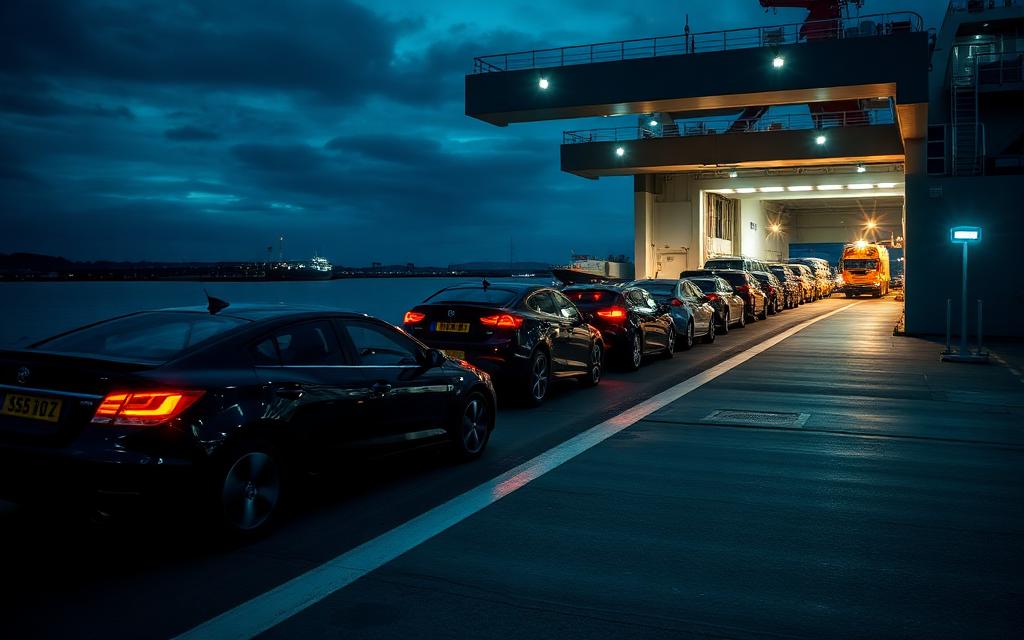
The two main methods of shipping a vehicle by sea
When a car, van or motorcycle needs to travel overseas, the vast majority of movements are handled by one of two methods: roll-on roll-off (RoRo) or containerised shipping. RoRo vessels are purpose-built car carriers with internal decks and ramps, and the vehicle is driven or winched aboard under its own power or on a trolley, then secured in place for the voyage. Containerised shipping instead loads the vehicle into a steel box, usually a 20ft or 40ft unit, which is then lifted onto a standard container vessel alongside general cargo. Both are mature, well-proven methods used on trade lanes worldwide, and neither is inherently better; the right choice depends on the vehicle, the route, the budget and how much control the owner wants over handling and paperwork.
Our freight desk is regularly asked to explain the difference in plain terms before a booking is made, because the decision affects price, transit time, security and the amount of documentation required at both ends. A classic saloon travelling from Southampton to a major RoRo hub such as Mombasa or Jebel Ali will usually move by RoRo, while a modified performance car or a vehicle bound for a country with limited RoRo infrastructure will often travel in a container. Understanding the practical differences before committing to a method avoids costly changes of plan later, particularly once a vehicle has already been delivered to a port for a specific sailing.
How RoRo shipping works in practice
A RoRo booking begins with the vehicle being driven or towed to a designated port terminal ahead of a cut-off date, typically three to seven working days before the vessel sails. Terminal staff record the condition of the vehicle, check that fuel is at a low level for safety reasons, and confirm the keys and documents match the booking. The car is then driven aboard by trained stevedores and lashed to the deck using wheel chocks and straps, sitting alongside hundreds of other vehicles on multiple decks. Because nothing is boxed or crated, RoRo is generally the most cost-effective way to move a standard road-going car, van or high-and-heavy item such as a tractor or excavator that can be driven aboard.
The trade-off is reduced control over the environment the vehicle experiences and, in a small minority of cases, exposure to superficial marks from tightly packed decks and general handling. Reputable operators file a detailed condition report with photographs before loading, and most claims for scuffs or dents are resolved through the marine insurance taken out for the voyage rather than disputed after the fact. RoRo also suits owners who need a straightforward, predictable service on a well-served corridor, since sailings on major routes such as UK to West Africa or UK to the Gulf run on a regular weekly or fortnightly schedule with established transit times.
How containerised vehicle shipping works
Containerised shipping places the vehicle inside a sealed steel box, either alone in an exclusive-use container or shared with one or more other vehicles or general goods in a groupage arrangement. The car is driven or winched into the container at a warehouse or terminal, secured with wheel chocks, ratchet straps anchored to the container floor rings, and sometimes timber bracing, before the doors are closed and sealed with a numbered security seal. That seal number is recorded on the shipping documents and should remain unbroken until the container is opened by the consignee or customs at destination, giving a verifiable chain of custody for the entire voyage.
Because the vehicle is enclosed and immobile from the moment the doors close, containerised shipping offers a meaningful reduction in exposure to weather, salt air and incidental contact with other cargo. It is the preferred method for classic and collector vehicles, right-hand drive cars going to left-hand drive markets where RoRo infrastructure may be thinner, motorcycles that need crating, and any vehicle the owner wants to arrive exactly as it left, with no possibility of another vehicle being loaded against it. Sharing a container with a second vehicle or with household effects can bring the cost down considerably compared with an exclusive booking, provided both parties are comfortable with a shared transit and a slightly longer window to find a compatible sailing partner.
Comparing indicative costs between the two methods
Cost comparisons between RoRo and containers are route-specific and change with fuel surcharges, currency movements and vessel availability, so any figures should be treated as an indicative guide rather than a fixed quote. As a general rule, RoRo is the cheaper option for a standard car on a route with good RoRo coverage, because the vehicle occupies only its own footprint on deck and no container hire, packing labour or destination handling charges apply. Containerised shipping typically carries a premium because of the cost of the box itself, the labour to load and secure the vehicle safely, and often higher destination terminal handling charges, since containers are handled by dedicated equipment rather than simply driven off a ramp.
That said, the gap narrows considerably when a container is shared between two or more vehicles, and it can reverse entirely on routes where RoRo services are infrequent or non-existent, forcing a longer, more expensive routing via a transhipment port. It is also worth weighing the cost of a container against the cost of any additional insurance excess reduction, professional detailing after a RoRo voyage, or the peace of mind of a sealed unit for a high-value car. Our freight desk always provides both options side by side wherever a route supports them, so the decision can be made on genuine like-for-like figures rather than assumption.
Paperwork common to both shipping methods
Regardless of method, exporting a vehicle from the UK requires a set of core documents: the original V5C registration certificate (or evidence of ownership if the vehicle is not UK registered), a valid export MOT or roadworthiness check where applicable, proof of purchase for newer vehicles, and, for most destinations, an export customs declaration lodged through the National Export System. Many destination countries also require a certificate of conformity, an original commercial or sale invoice showing the purchase price, and a bill of lading naming the consignee who will clear the vehicle at the far end. Missing or mismatched paperwork is the single most common cause of delay at destination, often adding weeks of storage charges while documents are corrected and resubmitted.
For older or classic vehicles, some destinations impose age restrictions or require additional heritage documentation, and it is worth checking these rules before booking rather than after the vehicle has sailed. Left-hand drive conversions, modified vehicles and those without a current registration in the country of dispatch can also trigger extra scrutiny from both UK export control and destination customs. Our freight desk reviews the full document set against the specific requirements of the destination country before confirming a sailing, because a single missing stamp or an invoice that does not match the declared value can hold a vehicle at the port long after the ship carrying it has already discharged.
Marine insurance and condition reporting
Marine cargo insurance is available for both RoRo and containerised movements and is strongly recommended even where a carrier offers a limited liability scheme as standard, since standard liability is usually calculated by weight rather than value and rarely reflects the true worth of a vehicle. A proper marine policy covers the agreed value, or an amount close to it, against loss, physical damage and, depending on the policy wording, mechanical or electrical breakdown caused by the voyage itself. Premiums are generally calculated as a small percentage of the declared value, and the exact rate depends on the route, the vessel type and whether the vehicle is driven, towed or non-runner.
A thorough condition report completed immediately before loading is the foundation of any successful claim should damage occur. This should include time-stamped photographs of all four sides, the roof, the interior, the odometer reading and any existing marks, ideally cross-checked against a written inspection sheet signed by the party handing the vehicle over. On arrival, the same process should be repeated before the vehicle leaves the destination terminal, so that any new damage can be identified and reported to the insurer within the policy time limit, which is often as short as three to seven days from discharge. Skipping this step, even on a short and apparently low-risk route, removes the evidence needed to support a claim later.
Destination port handling and customs clearance
Arrival is where the two methods diverge again. A RoRo vehicle is typically driven off the vessel directly to a holding area, inspected by destination customs, and released to the consignee once duties, taxes and any local levies have been paid and the paperwork verified. A containerised vehicle must first be discharged from the vessel as a container, moved to a container yard, and then either inspected still sealed or destuffed under customs supervision before the vehicle itself is released, adding one or two extra handling steps and typically a day or two to the process compared with RoRo in a well-run port.
Destination charges vary enormously between countries and even between neighbouring ports, and can include terminal handling fees, scanning charges, agency fees for the local clearing agent, and demurrage if the vehicle is not collected within the free storage period, which is often as short as five to ten days. It is essential to establish who is responsible for appointing and paying the destination agent before the vessel sails, and to have that agent primed with the full document set in advance, since agents working from an incomplete file are a common cause of avoidable delay and cost at the far end.
Choosing by vehicle type
Standard production cars, vans and pickups that are in running order and have no unusual dimensions are generally best suited to RoRo where the route supports it, since the cost saving is meaningful and the risk profile is well understood by carriers and insurers alike. Motorcycles almost always travel in a container, either crated individually or grouped with other bikes, because RoRo decks are not designed to secure two-wheeled vehicles safely on their own. Classic, vintage and collector vehicles, along with anything non-running, heavily modified, or fitted with aftermarket parts that project beyond standard dimensions, are usually better protected in a container, where they can be braced individually rather than sharing open deck space with hundreds of other vehicles.
High and heavy plant, oversized 4x4s with roof-mounted equipment, and vehicles carrying personal effects inside the cabin also tend to favour containerised shipping, since a sealed box allows goods to travel with the vehicle in a way that most RoRo carriers do not permit for security and customs reasons. Where a client is shipping several vehicles at once, a mixed strategy is often sensible: everyday runners going by RoRo to keep costs down, with the one high-value or delicate vehicle in the group travelling separately in a container.
Choosing by destination and trade lane
Destination infrastructure is often the deciding factor regardless of vehicle type. Major RoRo hubs, including several ports in West Africa, the Gulf, the Indian subcontinent and parts of the Mediterranean, receive dedicated car carrier services on a frequent, published schedule, which keeps RoRo pricing competitive and transit times predictable on those lanes. Other regions have little or no direct RoRo service, meaning a vehicle would need to be trucked or transhipped through a third country to reach a suitable ramp, a process that often erodes any cost advantage RoRo would otherwise have and introduces additional handling risk.
Container shipping, by contrast, follows the same global network used for general trade, so almost any port with a container terminal can receive a vehicle in a box, even where no RoRo service exists at all. For destinations with strict import rules, such as requirements for the vehicle to arrive in a sealed, tamper-evident unit or restrictions on vehicles arriving without accompanying paperwork inside a locked container, containerised shipping is sometimes the only compliant option. Checking the specific import regime of the destination country before booking, rather than defaulting to whichever method is cheaper on paper, avoids a vehicle being refused entry or held indefinitely at the border.
Transit times and scheduling considerations
RoRo services generally run to fixed, advertised schedules with a known transit time, since the vessels are dedicated to vehicle cargo and follow set rotations between a limited number of ports. This predictability makes RoRo well suited to time-sensitive movements, such as vehicles needed for a specific event or a buyer waiting to register a car by a certain date. Containerised shipping transit times depend on the container vessel network serving the route, which can involve one or more transhipment ports, and while headline transit times are often published, real-world arrival can vary if a connecting vessel is delayed or a transhipment port experiences congestion.
Booking lead times also differ: RoRo space on popular lanes can fill up two to three weeks ahead of a sailing during busy periods, particularly around seasonal peaks, while container space is generally easier to secure at short notice because of the sheer number of weekly sailings on most major trade lanes. Anyone working to a hard deadline should build in a margin for both documentation processing and potential schedule slippage, and should confirm the actual cut-off date for cargo receipt at the terminal, which is almost always earlier than the advertised sailing date.
Common mistakes to avoid
The most frequent error is assuming price alone should decide the method, without checking whether the destination country actually operates a suitable RoRo terminal or imposes conditions that effectively require a container. A second common mistake is under-declaring the value of the vehicle on export or insurance paperwork in the hope of reducing duty or premium costs, which can invalidate an insurance claim and create serious problems with destination customs if the discrepancy is discovered. A third is leaving personal belongings inside a vehicle destined for RoRo shipment, since most carriers explicitly prohibit this for security and liability reasons, and any items left inside are not covered by marine insurance and may be removed before loading.
Underestimating destination charges and clearance timelines is another recurring issue, particularly for first-time importers who budget only for the freight cost and are then surprised by terminal handling fees, agency charges and demurrage once the vehicle arrives. Finally, failing to keep the original bill of lading and other release documents secure, or delaying their transmission to the consignee, can prevent a vehicle being collected even when it has arrived safely and cleared customs, since most ports will not release a vehicle without sight of the correct release paperwork or, on some routes, a telex release confirmed by the shipping line.
Getting a written quote for your vehicle
Every vehicle and route combination has its own best answer, and the only reliable way to compare RoRo and container costs properly is to work from the actual specification of the vehicle and the confirmed destination. Send through the make, model and dimensions of the vehicle, whether it is in running order, the collection or drop-off location in the UK, and the destination port or city, and our freight desk will provide a written quote setting out both RoRo and containerised options where the route supports them, along with the documentation required at each end. Where a route only realistically supports one method, that will be explained clearly, along with the reasoning, so the decision can be made with full visibility of the costs, the timeline and the paperwork involved before anything is booked.
Need this shipped?
We book vehicle, container and air freight movements out of the UK every week and file the customs entries in house. Send the dimensions, the destination and the date you need it there, and we will price it properly in writing.