
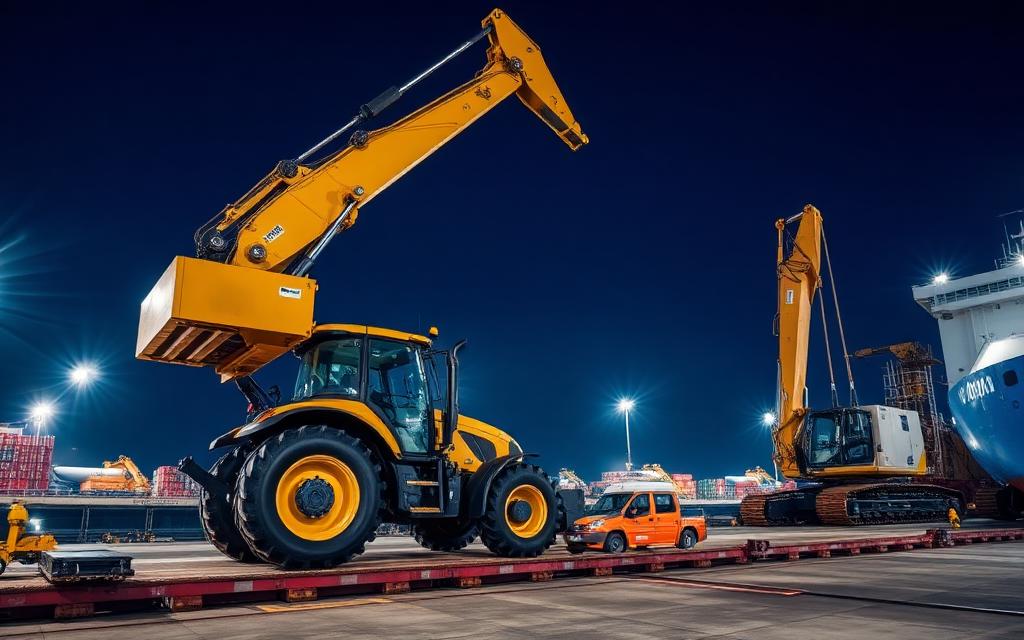
Why plant and agricultural machinery needs a different approach
Tractors, combine harvesters, excavators and other heavy plant present a different set of challenges to a family saloon or a pallet of general cargo. The units are large, often oddly shaped, frequently fitted with attachments that extend beyond the main chassis, and in many cases carry residual fuel, oil and hydraulic fluid that has to be managed before the item can be accepted for carriage. Getting the method wrong can mean a booking is rejected at the terminal gate, a vessel space is lost, or a consignment is delayed at destination while paperwork or cleaning certificates are chased up. Because every machine is slightly different, we treat each shipment as an individual planning exercise rather than a standard product, starting with accurate measurements and a clear understanding of how the item will be loaded, secured and discharged at the far end.
The commercial stakes are usually higher than with a car shipment too. A used tractor or excavator can represent a significant investment for the buyer, and a delay of even a few weeks can affect a farming season or a construction schedule. Agricultural machinery is also one of the categories most closely scrutinised by biosecurity authorities in destination countries, because soil, plant material and pests can travel undetected in tyre treads, tracks and undercarriages. This guide sets out the practical steps involved in moving plant and agricultural equipment by sea, from initial measurement through to collection at the destination port, so that owners and buyers know what to expect and what to prepare before the machine is booked onto a vessel.
Measuring and describing the machine correctly
Every quotation and booking for plant machinery starts with dimensions: overall length, width, height and weight, plus the position of the centre of gravity if it is unusual. Many machines look straightforward on a specification sheet but change shape once attachments, buckets, forks or booms are fitted. An excavator with the boom extended forward, or a telehandler with forks raised, can add a metre or more to the stated length, and this additional reach often determines whether the unit fits into a standard container, needs a flat rack, or must travel on a RoRo vessel deck instead. We always ask for photographs from the front, rear, both sides and directly above where possible, since these help identify protruding mirrors, exhaust stacks, counterweights or hydraulic rams that are easy to overlook in a written description.
Weight distribution matters as much as total weight. A wheeled loader with a full counterweight at the rear behaves differently under lashing loads than a tracked excavator with its weight spread evenly along the undercarriage, and this affects both the securing method and the choice of trailer or ramp used to load it. Ground pressure is another factor that is often missed: tracked machines can exert very high point loads on ramps, container floors and terminal surfaces, and some ports will ask for load-spreading mats or timber packing before allowing a heavy tracked unit to cross a weighbridge or ramp. Declaring accurate axle weights, track widths and ground clearance up front avoids last-minute problems when the machine actually arrives for loading.
Dismantling and reducing the shipping footprint
Partial dismantling is one of the most effective ways to bring down cost and widen the range of shipping methods available, particularly for machines that only just exceed a container's internal dimensions. Removing a bucket, ripper, cab canopy, exhaust stack, mirrors or counterweight can turn a unit that would otherwise need an open-top container or flat rack into one that fits inside a standard high-cube box, at a noticeably lower freight rate. Attachments that are removed are usually packed alongside the machine, either strapped to the chassis, placed in the bucket itself, or crated separately, with all fixings, pins and bolts labelled and bagged so that reassembly at destination is straightforward.
The decision to dismantle should always be balanced against the labour, time and risk involved. Removing a boom or counterweight requires suitable lifting equipment and a competent operator, and reassembly at destination needs the same. For older or well-used machines, unnecessary dismantling can also introduce wear on fittings that were not designed to be removed and refitted repeatedly. Our general approach is to dismantle only what is needed to achieve a meaningful reduction in shipping cost or to fit a specific transport method, and to document the original configuration thoroughly with photographs so the receiving party can rebuild the unit exactly as it left the yard.
Biosecurity cleaning and pest inspection requirements
Agricultural and earthmoving machinery is subject to some of the strictest biosecurity controls in international freight, because tracks, tyres, undercarriages and cab floors readily trap soil, seeds, straw, manure and insects. Countries such as Australia and New Zealand apply particularly rigorous inspection regimes on arrival, and a machine found to be contaminated can be held, professionally cleaned at the importer's expense, or in serious cases refused entry altogether. Even destinations with less publicised biosecurity regimes increasingly apply similar checks, so cleaning should be treated as a standard step for any used plant or agricultural machine rather than something only relevant to a handful of markets.
A thorough pre-shipment clean covers the undercarriage, wheel arches, tyre treads or track pads, the engine bay, radiator fins, cab floor mats and any recesses where mud or plant matter can collect. Pressure washing is usually the most effective method, followed by a visual inspection once the machine has dried, since residual soil is easier to spot on a dry surface. Where a destination country requires it, we can arrange for the clean to be carried out by an approved facility and for a wash certificate to be issued, which is then submitted alongside the other shipping documents. Retaining dated photographs of the cleaned machine, particularly the underside and tracks, is good practice and can help resolve any dispute over condition on arrival.
Choosing between RoRo, flat rack and open-top container
Roll-on roll-off shipping is generally the most cost-effective method for self-propelled machines that can be safely driven or towed up a ramp under their own power or with a tow bar, such as tractors, combine harvesters and many wheeled loaders. RoRo vessels are designed for wheeled cargo, loading is relatively quick, and rates are usually calculated on a measurement basis rather than a fixed container price, which can work in favour of compact but heavy units. The trade-off is a more limited route network compared with container shipping, and less protection from the elements during the voyage compared with a closed box, so it tends to suit robust, weather-tolerant machinery rather than anything with sensitive electronics or unprotected paintwork.
Flat rack containers are the standard solution for machines that are too large, too heavy or too irregularly shaped for a standard box but do not need full enclosure. The absence of side walls allows attachments, wide tracks or overhanging booms to project beyond the container's footprint within agreed limits, and the flat deck gives strong, direct lashing points for chains and turnbuckles. Open-top containers, by contrast, retain the side walls but remove the roof, which suits taller machines or those that need to be loaded from above by crane, while still offering some protection from spray and rain when a tarpaulin is fitted. The right choice depends on the machine's dimensions, the ports being used, and how much weather exposure is acceptable during transit.
Standard enclosed containers remain the preferred option whenever a machine can be dismantled or is naturally compact enough to fit, since they offer full protection from weather and reduced risk of pilferage, and they are compatible with the widest range of trade lanes and inland transport options at both ends. For high-value or electronically sensitive equipment, such as modern tractors with complex cab electronics and GPS guidance systems, the enclosure of a standard container is often worth prioritising over the cost savings of an open method, even where the dimensions are borderline.
Lashing, securing and preventing movement in transit
Whichever method is used, the machine has to be immobilised so that it cannot shift, roll or tip during the voyage, when the vessel may encounter significant rolling motion in open water. On a flat rack or in an open-top container, this typically means chocking the wheels or tracks with timber, securing chains or wire lashings to certified lashing points on the chassis, and tensioning with turnbuckles to a specified load rating. Handbrakes are applied and, where fitted, park locks or transmission locks are engaged, and hydraulic rams are retracted and, where possible, mechanically pinned to prevent creep from pressure changes during the voyage.
Lashing calculations take into account the weight of the machine, the number and rating of the lashing points, and the anticipated forces from pitching, rolling and braking during loading and discharge. Using the machine's own structural points rather than convenient but non-rated brackets is essential, since an incorrectly loaded lashing point can fail under load and allow movement that damages both the machine and neighbouring cargo. For RoRo shipments, the vessel operator's own securing crew typically applies lashings to the vessel's deck fittings according to the shipping line's approved plan, and photographs of the completed lashing are usually available as part of the loading record.
Managing fuel, oil and other hazardous fluids
Machinery arriving with a full fuel tank, topped-up hydraulic reservoir or leaking seals creates both a safety hazard and a regulatory problem, since most shipping lines and terminals impose strict limits on residual fuel levels for vehicles and plant travelling by sea or air. As a general guide, fuel tanks are usually required to be no more than a quarter full, batteries should be disconnected or have terminals insulated to prevent short circuits, and any obvious oil, coolant or hydraulic fluid leaks need to be identified and rectified before the unit is presented for loading. These are indicative industry norms rather than fixed rules, and the exact requirement can vary by carrier and destination, so it is worth confirming specifics before the machine leaves the yard.
Where a machine cannot be practically drained, such as a sealed hydraulic system, the fluid is generally acceptable provided there is no risk of leakage and the system is not classified as carrying a hazardous substance requiring special dangerous goods documentation. Batteries in particular deserve attention, since a loose or unprotected terminal can cause a fire if it contacts metal during transit, and many carriers now ask for a written confirmation that batteries have been isolated. Any residual fluids that do need to be present, such as engine oil for lubrication, should be at normal working levels only, with drip trays or absorbent matting used during loading to catch any incidental leakage and keep the vehicle deck or container floor clean.
Documentation, valuation and export compliance
Plant and agricultural machinery shipments typically require the same core documentation as any other export: a commercial invoice or valuation, proof of ownership such as a registration document or bill of sale, and export declaration paperwork lodged with customs. Machines that were originally manufactured outside the UK, or that have been modified with imported parts, may also need supporting paperwork to establish origin for the buyer's own import purposes, since preferential duty rates in the destination country can depend on where the equipment or its major components were built. Serial numbers and engine numbers should match across all documents, since a mismatch is one of the most common causes of hold-ups at destination customs.
Accurate valuation matters for insurance as much as customs. Understating the value to reduce duty exposure at destination is not something we can support, and it also leaves the owner underinsured if the machine is damaged or lost in transit. Where a machine has had recent parts replaced, an engine rebuild, or significant attachments added, these should be reflected in the declared value and supported with invoices where available. For machines being shipped for repair, exhibition or temporary use rather than permanent sale, a temporary export or carnet arrangement may be more appropriate than a standard commercial export, and this should be discussed with our freight desk before booking so the correct paperwork is used from the outset.
Destination handling, discharge and inland delivery
Arrival at the destination port is only part of the journey. Heavy machinery needs suitable lifting or ramp facilities to come off the vessel or out of the container, and not every port or inland terminal is equipped to handle a forty-tonne excavator in the same way as a car or a pallet of boxed goods. Confirming in advance that the destination terminal has the crane capacity, RoRo ramp access, or forklift rating needed for the specific machine avoids a situation where the unit arrives but cannot be safely discharged without additional equipment being brought in, which adds cost and delay.
Once discharged, inland delivery to a farm, depot or construction site often requires a low-loader or specialist trailer, particularly for tracked machines that are not permitted or practical to drive on public roads over any distance. Route surveys may be needed for very large or heavy units to check bridge weight limits, width restrictions and turning circles on the final approach to the delivery address. Import customs clearance, biosecurity inspection where applicable, and any local registration or roadworthiness requirements for self-propelled machines should all be arranged before the vessel arrives, so the machine does not accumulate storage charges while waiting for paperwork to be finalised at the destination terminal.
Insurance considerations specific to heavy machinery
Marine cargo insurance for plant and agricultural machinery should reflect the actual risks involved, which differ from those of a standard vehicle. Exposed hydraulic rams, glass cab panels, gauges and electronic control units are all vulnerable to knocks during loading and lashing, and a policy should make clear whether cosmetic damage, such as scratched paintwork or a cracked light lens, is covered alongside major structural or mechanical damage. Total loss cover is relatively straightforward to arrange, but partial damage claims on complex machinery can be more involved, since assessing repair cost may require a specialist engineer's report from the destination country.
It is worth confirming what happens in the event of a claim involving attachments or parts that were shipped separately from the main machine, since a bucket or set of forks despatched in a different container could otherwise fall outside the scope of a policy written only against the main unit's value. Keeping a single consolidated valuation and insurance schedule covering the machine and all its shipped attachments, supported by the pre-shipment photographs and any wash or condition certificates, gives the clearest basis for a smooth claim if something does go wrong in transit.
Typical timelines and planning ahead
Sailing schedules for RoRo and container services vary by trade lane, and while some routes to Northern Europe operate frequently, longer-haul destinations such as parts of Africa, the Middle East, Asia-Pacific and the Americas may only be served by a vessel every few weeks. Booking cut-off dates for documentation, cleaning certificates and physical delivery to the port or container yard are usually set several days before the vessel's departure, and missing a cut-off generally means waiting for the next available sailing rather than a short delay. Building in time for dismantling, cleaning and any repairs identified during pre-shipment inspection is therefore just as important as booking the freight itself.
As a general guide only, and always subject to the specific trade lane and carrier schedule at the time of booking, transit times can range from a few days for short-sea RoRo movements to Northern Europe up to several weeks for deep-sea routes to Australia, New Zealand or South America. These figures are indicative rather than guaranteed, since vessel schedules, port congestion and seasonal demand for agricultural machinery around planting and harvest periods can all affect actual sailing dates. Planning a shipment with a reasonable buffer before the machine is needed on site avoids the pressure of trying to expedite a booking at short notice.
Get a written quote for your plant or agricultural machinery shipment
Every machine we quote for is assessed individually, taking into account its exact dimensions, weight, attachments and condition, together with the collection point, destination port and any biosecurity or customs requirements specific to the receiving country. Rather than relying on generic estimates, we ask for photographs, a specification sheet where available, and details of any dismantling already planned, so the quotation reflects the shipment as it will actually travel rather than a rough approximation.
If you have a tractor, excavator, harvester or other item of plant or agricultural machinery to move, send us the make, model, dimensions, weight and current location, along with the destination address, and our freight desk will come back with a written quotation setting out the recommended shipping method, indicative timeline and the documentation you will need to prepare in advance.
Need this shipped?
We book vehicle, container and air freight movements out of the UK every week and file the customs entries in house. Send the dimensions, the destination and the date you need it there, and we will price it properly in writing.